
Patrik Thomas Michalski

Researcher and developer

Patrik ThomasMichalski

Focus: Spatial data systems and applied data science

Currently at Kiel University, Archaeoinformatics – Data Science Group

Patrik Thomas Michalski

About me

I work at the intersection of research and software development. Since January 2023, I have been a research associate in Prof. Dr. Matthias Renz’s Archaeoinformatics – Data Science Group at Kiel University. My work focuses on spatial and spatio-temporal data, especially when datasets are incomplete, heterogeneous, or were collected for a different purpose.

My project work includes collision-risk-aware ship routing, skyline queries in bicriteria networks, and synthetic process data for metal forming. I contributed to Marispace-X, DFG Priority Programme 2422, and NFDIxCS. Since July 2026, I have also worked on forecasting regional care demand in Pflege-Prognose+. Several of these projects involved preparing research and funding proposals alongside the technical work.

I spent two research stays at Prof. Cyrus Shahabi’s InfoLab at the University of Southern California, in 2023 and early 2024. From April 2025 to June 2026, I worked in Prof. Dr. Agnes Koschmider’s Business Informatics and Process Analytics Group at the University of Bayreuth.

I hold bachelor’s and master’s degrees in computer science from Kiel University and am currently completing my doctorate there.

Focus

  • Spatial data analysis
  • Spatio-temporal modelling
  • Applied AI and machine learning

Programming languages

  • C
  • C++
  • Java
  • Python

Spoken languages

  • German, native
  • Polish, native
  • English, C1

Career

Positions, research stays and degrees, most recent first.

  1. since 01/2023

    Doctoral Researcher and Research Associate

    Present

    Kiel University · Kiel, Schleswig-Holstein, Germany

    Doctorate in computer science in the Archaeoinformatics – Data Science Group of Prof. Dr. Matthias Renz. Spatial data management, maritime routing and the generation of synthetic data.

  2. 04/2025 – 06/2026

    Research Associate

    University of Bayreuth · Bayreuth, Bayern, Germany

    Business Informatics and Process Analytics Group of Prof. Dr. Agnes Koschmider. Data-driven process modelling for metal forming, within DFG Priority Programme 2422.

  3. 01/2023 and 01–02/2024

    Research Stays at the InfoLab

    University of Southern California · Los Angeles, California, USA

    Two stays at the InfoLab of Prof. Cyrus Shahabi.

  4. 10/2020 – 12/2022

    M.Sc. Computer Science

    Kiel University · Kiel, Schleswig-Holstein, Germany

    Four semesters, completed with a Master of Science.

    Read the thesis: M.Sc. Computer Science
  5. 10/2018 – 12/2022

    Student Teaching Assistant

    Department of Computer Science, Kiel University · Kiel, Schleswig-Holstein, Germany

    Teaching support in the department, alongside my bachelor’s and master’s studies.

  6. 10/2017 – 09/2020

    B.Sc. Computer Science

    Kiel University · Kiel, Schleswig-Holstein, Germany

    Six semesters, completed with a Bachelor of Science.

    Read the thesis: B.Sc. Computer Science

Research projects

Selected research and development projects, including my contribution to each.

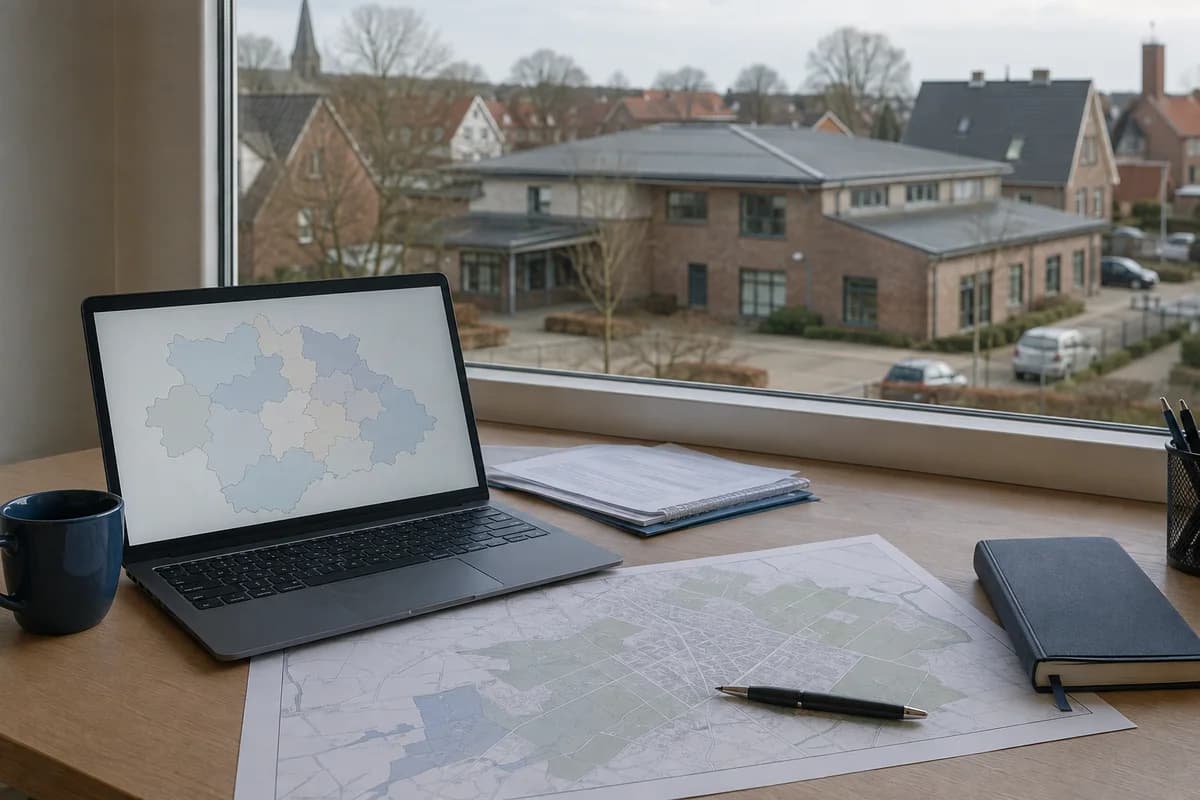
Regional planning documents and a map on a desk by a rain-covered window
since 07/2026OngoingPflege-Prognose+State of Schleswig-Holstein, AI funding guidelineThe project builds an early-warning system that forecasts regional care demand in Schleswig-Holstein, so that care providers and the state administration can see developments such as demographic change or regional shortages before they take effect. The main difficulty is the data itself: care facilities record far less, and far less consistently, than hospitals do. The state funds the project with about €400,000.Open project details
Regional planning documents and a map on a desk by a rain-covered window
since 07/2026Ongoing

Pflege-Prognose+

Funding and context
State of Schleswig-Holstein, AI funding guideline

About the project

Pflege-Prognose+ is the forecasting component of Schleswig-Holstein's digital care-demand survey. Together with Pflege-Monitor+, it is intended to combine continuously updated data from municipalities, care providers and state authorities. The forecasts are then prepared for a dashboard so that regional differences, demographic shifts and emerging shortages can be recognised earlier.

The research problem starts before a model is trained: the relevant data is distributed across organisations, collected at different intervals and not always described in the same way. This makes data integration, transparent assumptions and an honest treatment of uncertainty central parts of the work.

I have been working on the forecasting project since July 2026. My contribution is in the computer-science and data-analysis part of the project, with a focus on regional care demand. Specific methods and results will be added here once they can be published.

Project website
Research archive with storage systems, data carriers and documentation
01/2026 – 06/2026NFDIxCSNational Research Data Infrastructure (NFDI)NFDIxCS is one of 26 consortia in the National Research Data Infrastructure funded by the German federal and state governments, and brings together 17 co-applicant institutions to build FAIR research data management for computer science. My contribution concerns schema expansion for empirical research knowledge, so that heterogeneous research data objects, meaning the data, the software and the context it was executed in, can be reused and cited.Open project details
Research archive with storage systems, data carriers and documentation
01/2026 – 06/2026

NFDIxCS

Funding and context
National Research Data Infrastructure (NFDI)

About the project

NFDIxCS develops a shared research-data infrastructure for computer science. Its scope includes datasets as well as software and the technical context required to understand or reproduce a result. The consortium works on FAIR principles, persistent citation and interoperable services for complex, domain-specific research objects.

A central concept is the Research Data Management Container: related artefacts are bundled instead of being published as disconnected files. Metadata has to describe their relationships precisely enough for other researchers and services to find, interpret and reuse them.

My contribution focused on extending schemas for empirical research knowledge. I worked on representing heterogeneous research objects and their execution context in a structured form, so that data, software and documented dependencies remain connected and citable.

Project website
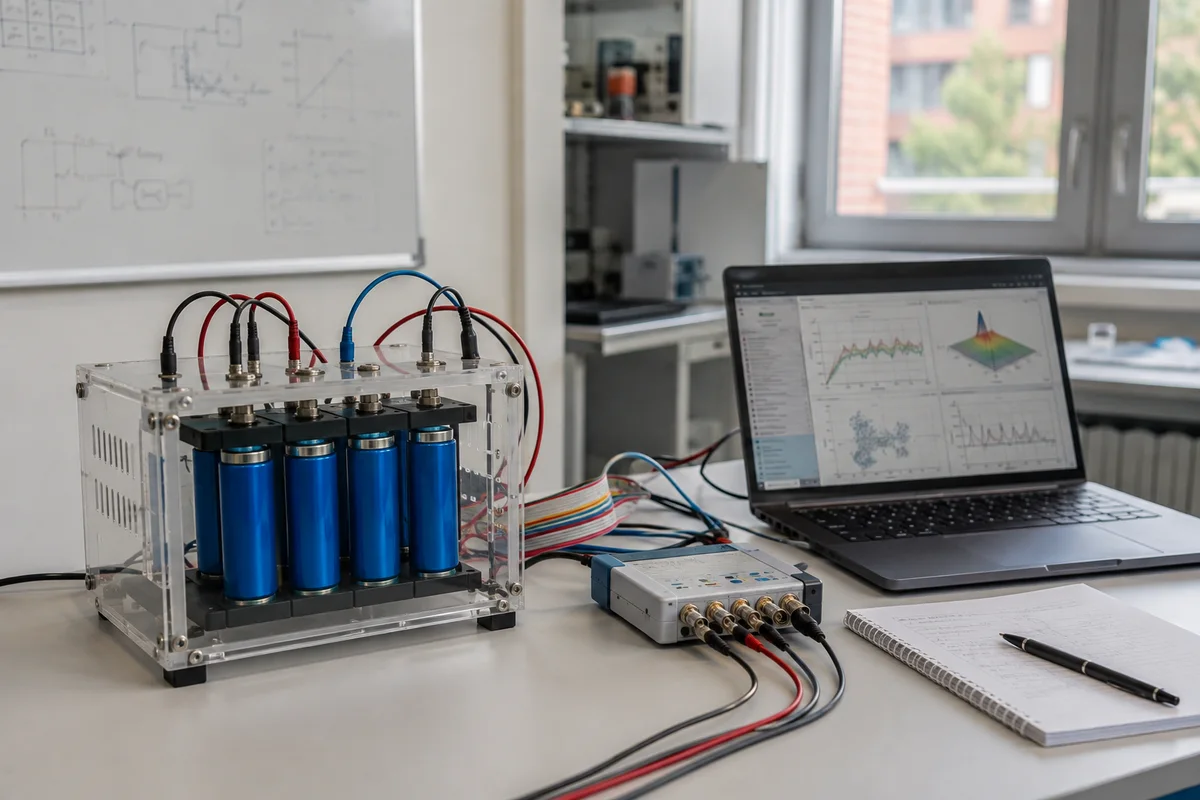
Shared research table with instruments, maps, notebooks and laptops
10/2025 – 12/2025KI@CAU Datencampus KielState of Schleswig-HolsteinThe Datencampus develops a shared data and AI strategy for Kiel University and makes it available across the state. The work runs in interdisciplinary tandems, among others with electrical engineering and physics, and covers how data is produced, how it is analysed and how it can be used again afterwards. The state funds the three-year initiative with about €2 million.Open project details
Shared research table with instruments, maps, notebooks and laptops
10/2025 – 12/2025

KI@CAU Datencampus Kiel

Funding and context
State of Schleswig-Holstein

About the project

KI@CAU Datencampus Kiel was established to make data and AI methods usable across disciplinary boundaries at Kiel University. The state funded the three-year initiative with about two million euros. Interdisciplinary tandems linked computer scientists with researchers from other fields and worked from data acquisition through analysis to later reuse.

The practical challenge is that disciplines use different instruments, formats and quality criteria. A shared strategy therefore cannot consist of one model or one platform. It needs transferable workflows, documented interfaces and enough domain context for results to remain interpretable.

During my involvement, I worked in this interdisciplinary setting, including exchanges with electrical engineering and physics. The focus was on connecting data-science methods with the way data is actually produced and evaluated in the participating disciplines.
Project website
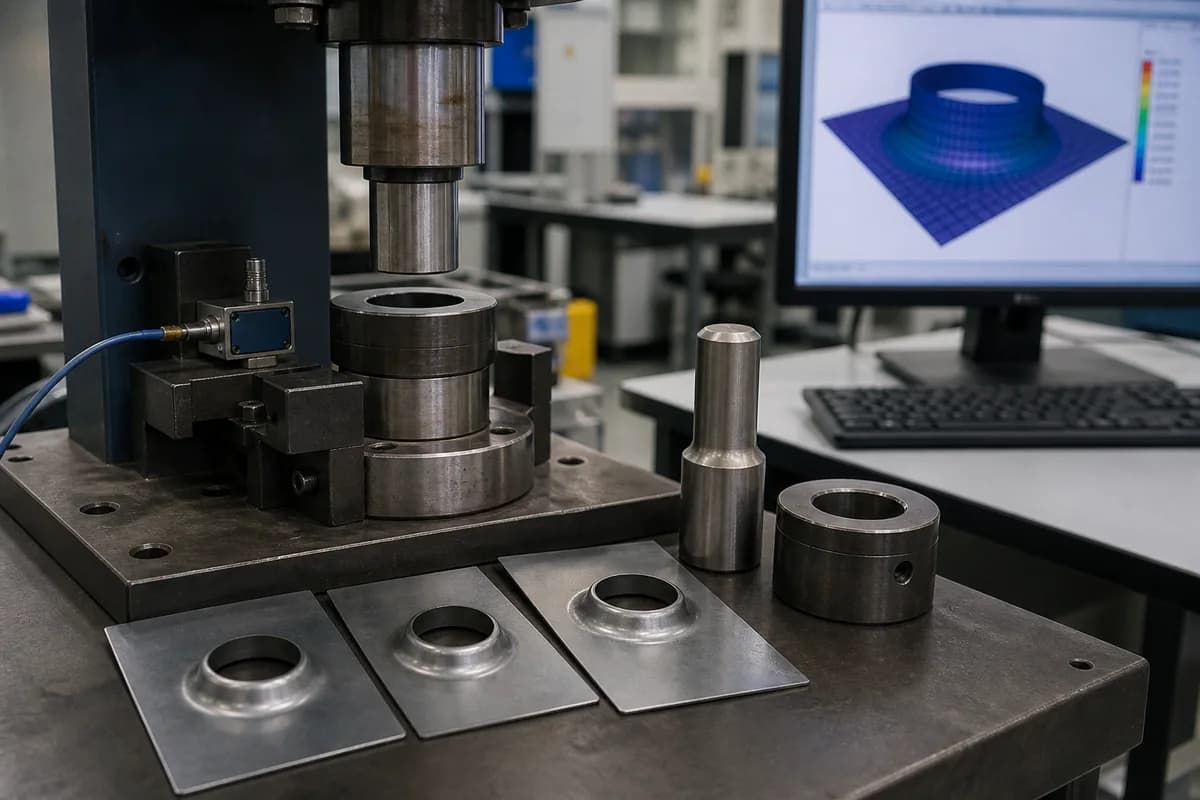
Instrumented metal-forming press with test specimens and a force curve
04/2025 – 09/2025DFG Priority Programme 2422German Research Foundation (DFG), University of StuttgartThe priority programme develops data-driven models of metal forming processes and combines sensor data with expert knowledge and FEM simulations. It runs nationwide with around a dozen subprojects and about €8.5 million in funding, coordinated by Prof. Mathias Liewald at the University of Stuttgart. Labelled process data is scarce in this field, so I built a controllable generator for synthetic force–displacement curves, which is used to train models that optimise active tool surfaces.Open project details
Instrumented metal-forming press with test specimens and a force curve
04/2025 – 09/2025

DFG Priority Programme 2422

Funding and context
German Research Foundation (DFG), University of Stuttgart

About the project

SPP 2422 combines process data, expert knowledge and solution spaces from simulations to model metal-forming operations. Institutes from forming technology, automation and data science work together so that generic mathematical representations can be tested against concrete manufacturing processes.

For machine learning, the available labelled measurements are a bottleneck. Real forming trials are expensive, process parameters interact and a model must still respect the physical character of a force–displacement curve. Synthetic data is useful only when these constraints remain controllable and traceable.

I developed a controllable generator for synthetic force–displacement curves. The generated process data supports the training and evaluation of models for active tool-surface optimisation without presenting synthetic curves as measured observations.

Project website
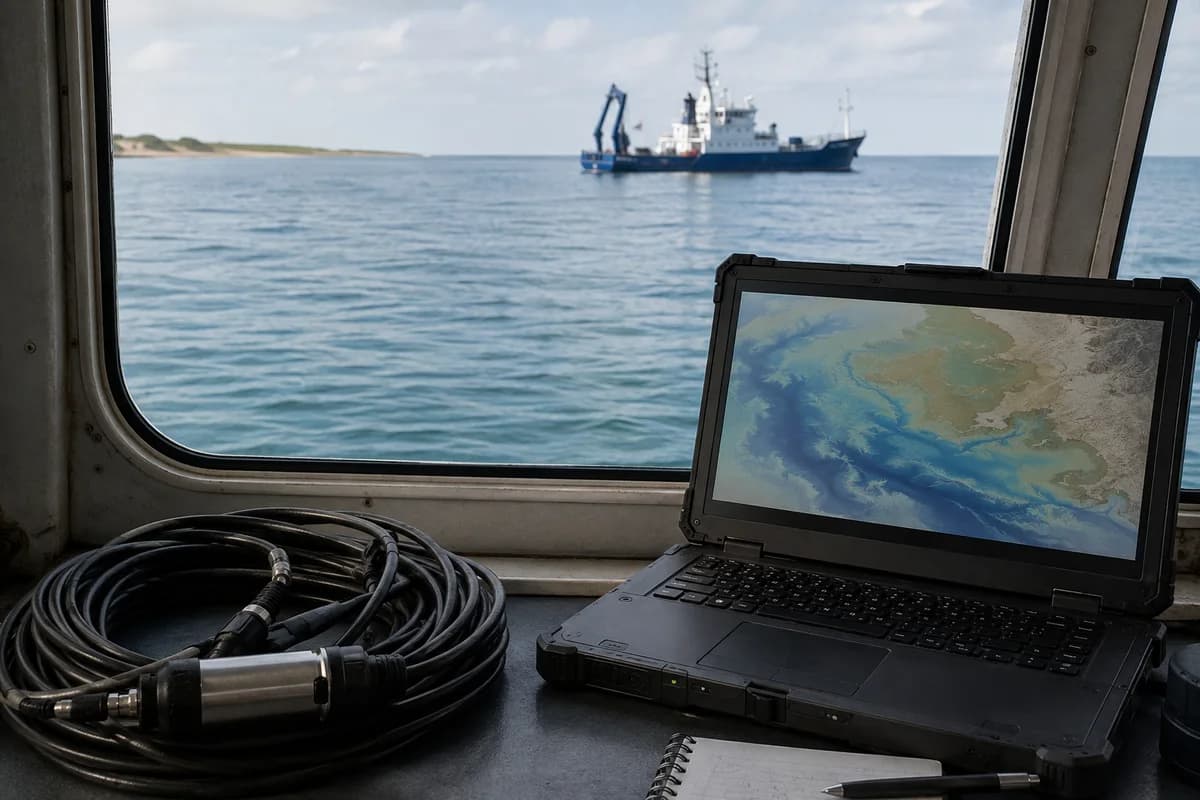
Marine survey equipment on a research vessel near an offshore wind farm
01/2023 – 03/2025Marispace-XGaia-X, coordinated by north.ioMarispace-X builds a data space for maritime sensor data within Gaia-X. The project was selected from more than 130 applications and received about €15 million in German federal funding; Kiel University takes part with seven working groups under Prof. Dr. Matthias Renz. My own work concerned collision-risk-aware ship routing and the management of the underlying spatial data. Use cases in the project include the exchange of survey data for offshore wind farms and the AI-supported search for historic munitions in the North and Baltic Sea.Open project details
Marine survey equipment on a research vessel near an offshore wind farm
01/2023 – 03/2025

Marispace-X

Funding and context
Gaia-X, coordinated by north.io

About the project

Marispace-X created a maritime data space based on Gaia-X principles such as data sovereignty, security, interoperability and modularity. Its architecture connects edge, fog and cloud processing so that large sensor datasets can be exchanged and analysed across organisational boundaries.

The use cases range from underwater sensor networks and offshore wind to the monitoring of critical infrastructure and historic munitions. They share a dependence on spatial data that arrives from different systems, at different resolutions and under different access conditions.

My work concerned collision-risk-aware ship routing and the management of the underlying spatial data. I investigated how route planning can account for other moving vessels instead of treating the sea as a static cost surface.

Project website

Publications

Conference and journal papers, including work that is accepted or still under review.

2027

  1. Under review

    SPIRE: Preference-Aware Linear Path Skyline Queries for Bicriteria Networks

    Preuß, N., Beth, C., Michalski, P. T., Wölker, Y., Mouratidis, K., Renz, M.

    Submitted to ACM SIGMOD/PODS 2027

2026

  1. Published

    A Collision-Risk-Aware Skyline Routing Framework for Maritime Navigation

    Michalski, P. T., Preuß, N., Renz, M., Tritsarolis, A., Pelekis, N., Theodoridis, Y.

    Proc. 27th IEEE Intl. Conf. on Mobile Data Management (MDM 2026)

  2. Published

    Tackling Data Scarcity: A Controllable Synthetic Data Generation Framework for Force–Displacement Curves

    Michalski, P. T., Fonger, F., Hahn, D. L., Kräusel, V., Koschmider, A., Renz, M.

    Proc. 27th IEEE Intl. Conf. on Mobile Data Management (MDM 2026)

  3. Accepted

    A-Posteriori Joint Schema Expansion for Empirical Research Knowledge in Computer Science

    Michalski, P. T., Britton, M., Maldonado, A., Almohaishi, M., Karras, O., Koschmider, A.

    4th NFDIxCS Symposium, INFORMATIK Festival 2026, Dresden, Germany

  4. Accepted

    The False Consensus Trap in Interdisciplinary Data-Driven Engineering Research Projects

    Baum, S., Michalski, P. T., Vogel-Heuser, B., Koschmider, A., Jazdi, N., Weyrich, M.

    31st IEEE ETFA 2026, Track 9, Västerås, Sweden

  5. Under review

    An Explainable Surrogate Model for Optimizing Active Tool Surfaces in Combined Shear Cutting and Collar Forming Processes

    Hahn, D. L., Fonger, F., Michalski, P. T., Riemer, M., Kräusel, V., Koschmider, A., Dix, M.

    Submitted to Springer journal Production Engineering

2024

  1. Published

    Collision-Risk-Aware Ship Routing

    Michalski, P. T., Preuß, N., Renz, M., Tritsarolis, A., Theodoridis, Y., Pelekis, N.

    Proc. 32nd ACM SIGSPATIAL '24, Atlanta, GA, USA, pp. 545–548

Contact

Use this form for technical exchange, project enquiries, or a professional conversation.